A.G. Lafley, Playing to Win: How Strategy Really Works (Book Review)
This book is justifiably famous for a strategy cascade that looks like this:
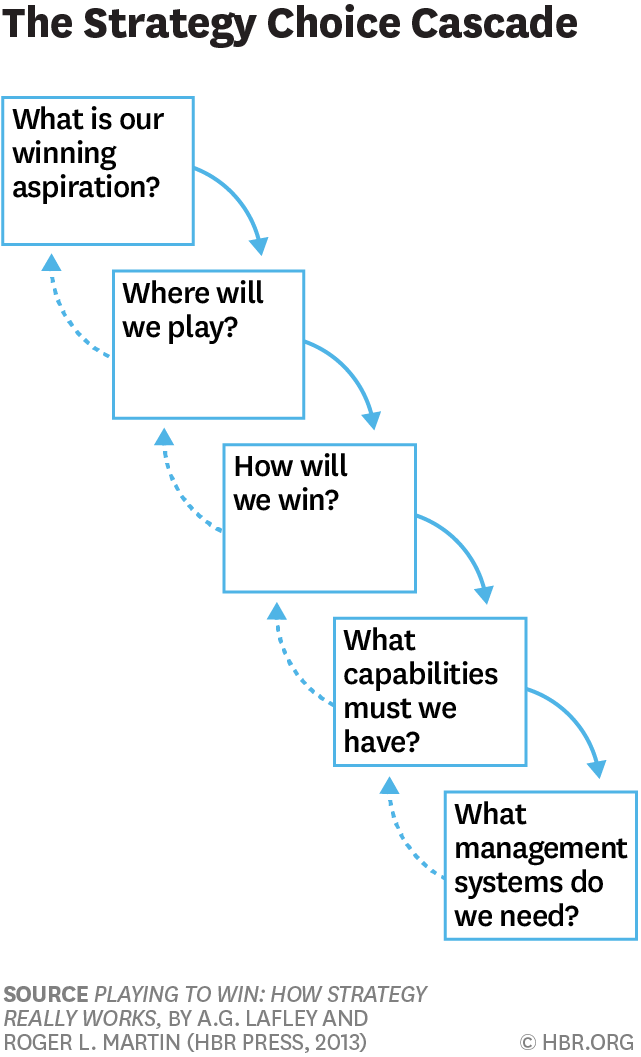
The key observation of the book of the book is that to answer each of these questions ("What is our winning aspiratioon?," etc.) you have to make choices. That's hard. The first six chapters set this out with case studies from Proctor & Gamble, and especially with regard to the repositioning of the old Oil of Olay into Olay, which was re-situated as a "masstige" product. The book mentions in passing the sell-off of major brands, such as Folgers and Pringles. I think the dumped products (ones for which P&G had to choose: "no") might have stories as interesting as Olay (and they would be all about strategy). In any case, there's a lot to learn in how each of the questions gets answered. That's what the first six chapters are about. I think almost anyone in a leadership role in business would get some value here. This is what I knew about the book before reading it: That it was largely a structural formula for deciding what to do (and not do). Because I get into a part of the process that needs to be "sequential" below, I want to note that the authors rightly say that all of the questions in the cascade have to be answered simultaneously: You can't afford to leave one hanging, which might leave a big hole in your execution.
But the book has a huge shift in chapters 7 and 8, and now I'm kind of befuddled that this part wasn't stressed by people who knew the book better than I. Chapter 7 defines a research process for getting sharp choices around the two key questions, where-to-play and how-to-win. This all builds on Porter's "five forces" but focuses on analysis so that you can find potential gaps (where you can lodge your business) in the competitive landscape/marketplace. I'm not going to detail it here: You'll have to read the book.
N0w, chapter 8. This is the best part. The authors characterize most strategy meetings as being about the consumption of reams of data and arguments over "the truth" and doing (choosing) the right thing. This kind of discussion creates winners and losers, and if someone is committed to an idea, they don't want to let go of it (pp. 183-185). What Roger Martin (who thought this up) does is replace the question "what is true?" with "what would have to be true?" (Think about that shift.) Now we can have a conversation with a lot of crazy ideas; if someone is poised to attack, you say: well, maybe that's crazy, but what would have to be true to actually do it?" Now we've turned acrimony into an interesting series of research questions. Indeed, Martin says that what you really want to do is organize these questions from hardest to easiest, and try to answer the hardest "what would have to be true" questions first: Because if you discover with one of the hard ones that there's no way to proceed, you don't need to do the rest. Essentially, Martin turns a conversation about a large body of hard-to-synthesize facts into a methodology that is a sequence of tests. I think this could be used at many levels in a modern business. It strikes me as a great way to proceed on build-vs-buy decisions. It reminds me a lot of Eric Reis's The Lean Startup but more geared to a corporation.
So why four stars rather than five? One gripe I have about this book is that it makes it sound as though strategy is always forward thinking, something you do when entering a new market or exploiting an opportunity. (That's a more heroic story for the authors.) So, for instance, in chapter 7 the authors mention Pampers as though the company was thinking in advance about possibilities in the diaper market (p. 170). But, in fact, there is a huge earlier section on Pampers (pp. 98-103) where one day P&G woke up to discover that Huggies had stolen their market because Huggies paid more attention to customer wants and needs. So, yes, P&G did turn the crank on this strategic approach as described in chapter 7, but it was entirely reactive. So my simple point here is that when you are trying to figure out where-to-play and how-to-win, you need to be doing it periodically: Not just when looking forward: Sometimes you are looking in the rear-view mirror, scared, and you need this process to re-situate.
Another gap in the book is that this is really, truly, about "products," i.e., consumer packaged goods. There is very little about services here, and I think the story would be quite different. (Services are mentioned in the appendices but not worked up.) For one thing, you make a commitment to many services over a longer period of time (perhaps a year-long contract) and the margins can be lower because dependent on headcount. By not discussing services, the book misses out on a lot of recent high tech. Also, while the book notes how Porter's "five forces" have a story around a channel possibly getting into your product area and overtaking you, the book doesn't have "Amazon" in the index. This P&G story is about great brands where no one would think to buy the generic product, but Amazon's pricing and distributing skills are so compelling I'd be shaking in my boots were I a traditional packaged goods company. I guess that story will have to wait for the next book from a P&G CEO.
Originally reviewed on Goodreads on 26 October 2020.
Comments